
The photographic gaze in the face of the collapse of polite society

A photographer’s view of the collapse of polite society
For more than a century, social photography, reportage and photojournalism have been observing the transformations of our societies. The role of the photographer is not only to produce beautiful images. It consists of bearing witness, documenting and sometimes revealing what the daily gaze no longer perceives.
Today, a phenomenon seems to be running through many democracies: the gradual disappearance of codes that allowed individuals to live together despite their differences. In the Anglo-Saxon world, some speak of the “Collapse of Polite Society”.
This expression does not simply refer to the disappearance of “hello” or good manners. She describes a society where mutual respect, listening and compromise gradually fade behind confrontation, mistrust and belonging.
The social photographer observes this evolution in the simplest gestures. A gaze that no longer meets. A conversation replaced by a screen. A neighbor who is no longer greeted. A waiting room where everyone remains locked in their own universe.
Social photography: witness to the transformations of the collective
The social photographer does not only photograph crises. It also documents the silent changes that are transforming everyday life.
Street photography often tells more than just news. It reveals the way in which individuals occupy a common space, share a place or ignore each other.
From Lewis Hine to Sebastião Salgado, Dorothea Lange, Robert Doisneau and W. Eugene Smith, social photography has always sought to put the human being back at the centre of the gaze.
These perpetrators were not looking for culprits. They sought to understand a society by showing its human consequences.
When Eyes No Longer Meet: The Disappearance of Acts of Civility
The gradual disappearance of politeness is less a problem than a symptom.
For a long time, Western societies operated on implicit rules: greet a stranger, listen before responding, respect a different opinion, or accept compromise.
These actions did not resolve conflicts. On the other hand, they often prevented disagreements from becoming ruptures.
The photographer notices these absences. Glances are avoided. Individuals share the same places without really meeting. Physical proximity no longer guarantees human proximity.
The correspondent, the reporter and the documentary photographer: telling the story of the fractures of the world
The correspondent, the reporter and the photojournalist have long been the eyes of a society that could not be everywhere.
They made wars, social crises, economic changes and human upheavals visible.
Robert Capa testified to the conflicts. Dorothea Lange revealed the consequences of the Great Depression. Robert Doisneau showed the poetry of human relationships. Sebastião Salgado documents migration, work and contemporary fractures.
All of them remind us of a simple idea: a photograph does not only inform. It allows for an encounter.
Politics or the art of separating rather than bringing together?
Democracy presupposes debate. However, this sometimes seems to give way to a logic of permanent confrontation.
The United States today offers the most visible example of this polarization. Political affiliations become social identities. The adversary is often perceived as a threat rather than an interlocutor.
This evolution goes beyond the American parties. It raises questions for all Western democracies.
A society is also weakened when it ceases to maintain dialogue, mutual respect and trust among its citizens.
The hot potato game: when responsibility becomes elusive
The photographer’s gaze does not stop at the citizens. He also observes the institutions.
When a problem arises, there is sometimes a sense that responsibility flows from one administration to another, from one politician to another or from one institution to another.
As in the game of hot potato, everyone seeks to pass on a responsibility that has become burning before having to assume it.
To this impression is sometimes added that of a world where economic imperatives take precedence over the collective interest. The search for profitability sometimes seems more visible than the search for sustainable solutions.
The photographer does not demonstrate these phenomena. He photographs their consequences: weariness, resignation, loss of trust and progressive distancing between citizens and institutions.
A society saturated with images, but deprived of a gaze
Our era produces more images than all previous generations combined.
However, producing images does not mean learning to look.
Social networks promote immediate reaction, strong emotion and confrontation. The time for observation is gradually disappearing.
The role of the author photographer then regains its full value. His work consists of slowing down the gaze, restoring complexity and reminding us that a face is never just an opinion.
Photography as the last meeting place
Photography will not reconcile a fragmented society. On the other hand, it can remind us of the obvious: behind every idea there is a person.
The role of the social photographer, the reporter and the director is precisely to preserve this encounter between the viewer and the viewer.
A society does not disappear because disagreements exist. It becomes fragile when it loses the ability to recognize the humanity of those who think differently.
Perhaps this is the most essential mission of photography: to bear witness before judging, to understand before condemning and to remind us that the first bond between two human beings always begins with a look.

Stéphan, photographer and director, began his career behind the lens before moving into documentary and advertising film production. In 2016, he founded his own studio and gallery, where striking visuals and digital marketing innovations come together. His avant-garde approach explores the boundaries of art and digital communication, brilliantly and accurately capturing the essence of the contemporary world.

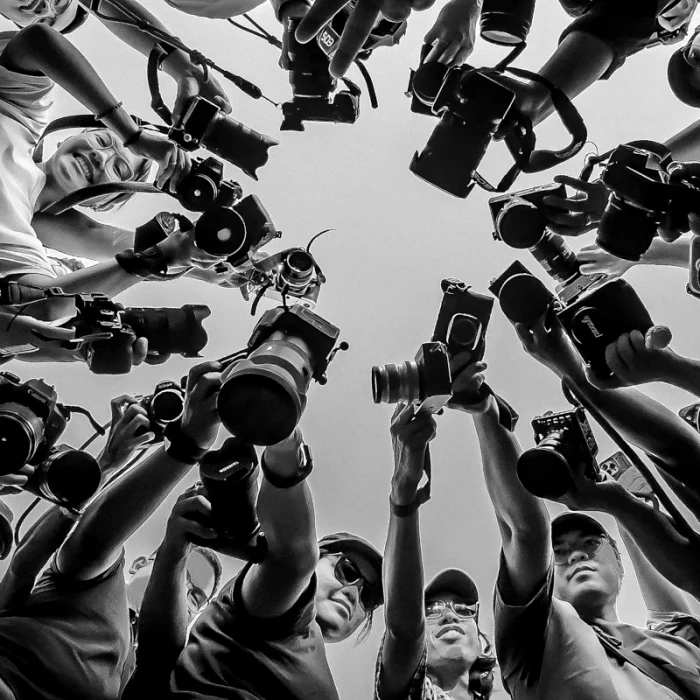
Traceability from the camera to the file broadcast.
Why make the origin of an image verifiable?