Free ports, art carriers and photographs: strategic documentation to secure and enhance the collections
Free ports, art carriers and photographs: strategic documentation to secure and enhance the collections



Free ports and storage spaces occupy a central place in the conservation of works of art. However, they represent only one step in a much larger journey. Today, the collections circulate between international fairs, galleries, institutions and private residences. In this context, fine art photography and expert documentation are becoming essential tools for insurers, art brokers, collectors and art transporters.
The works regularly leave free ports or storage areas to be presented at major events such as Art-Genève. Each trip involves significant conservation, insurance and liability issues.
In this context, rigorous visual documentation ensures continuity between each step. Photographing works of art or valuables makes it possible to precisely monitor the condition of the pieces before transport, during their exhibition and on their return. Thus, each actor has a reliable and consistent reference in an authentic report.
Art transporters work in demanding environments, whether they are fairs, galleries or private collections. Each operation requires absolute precision.
A condition report carried out in the photography of a work of art allows each step to be rigorously documented. Reports include overviews, macro photography details, and annotations. Each photograph is delivered in very high resolution and with optimized lighting. This ensures that details are accurately recorded. This method facilitates coordination between all stakeholders.
In the event of an incident, this traceability becomes a key element. It reduces uncertainty and speeds up compensation processes for both insurers and art carriers.
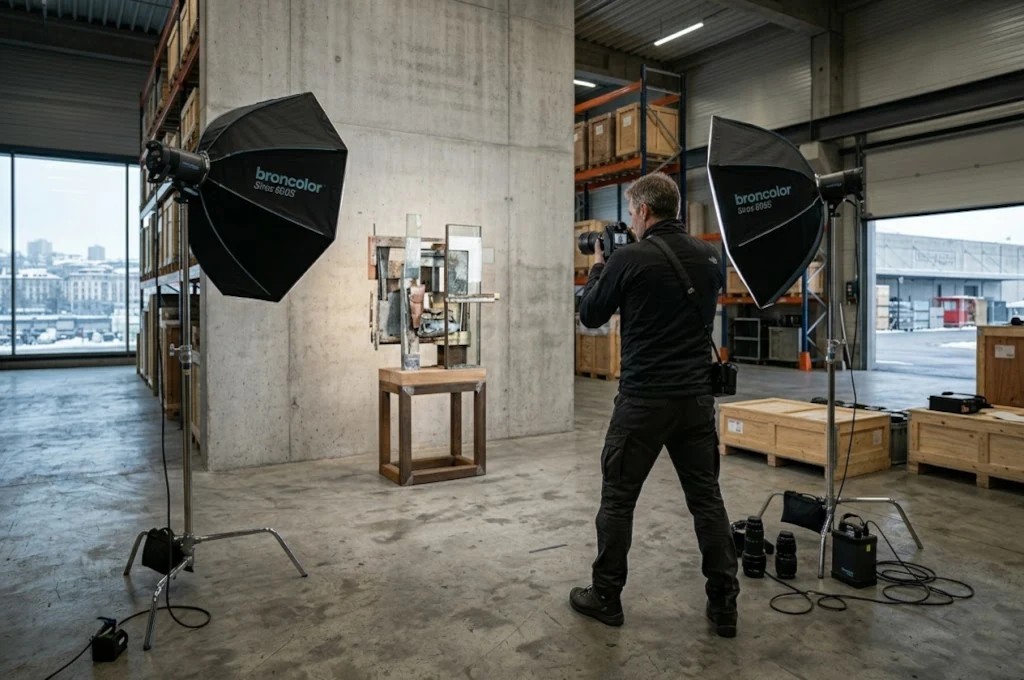
The photographic report goes beyond simple visual documentation. It structures the essential information related to the work: condition, specificities, and points of vigilance are printed.
For insurers, it improves risk assessment and secures contracts. For art brokers, it facilitates transactions and builds trust between the parties. For collectors, it offers a clear and rewarding vision of their heritage, whether it is kept in free ports or exhibited in places such as Art-Genève or in private collections.
Photography of works of art helps to maintain a continuous visual presence of the works, even when they circulate between different places.
A secure digital gallery or a tailor-made editorial catalog offers a fluid and controlled consultation. The work thus retains its visual impact, regardless of its physical location.
Limiting documentation to free ports alone is no longer enough. The art market requires constant mobility, between fairs such as Art-Genève, private salons, international exhibition galleries and private spaces.
In this context, the photography of works of art, in combination with art transporters, became a professional standard. It secures operations, structures exchanges and sustainably enhances the value of each work.

Stéphan, photographer and director, began his career behind the lens before moving into documentary and advertising film production. In 2016, he founded his own studio and gallery, where striking visuals and digital marketing innovations come together. His avant-garde approach explores the boundaries of art and digital communication, brilliantly and accurately capturing the essence of the contemporary world.

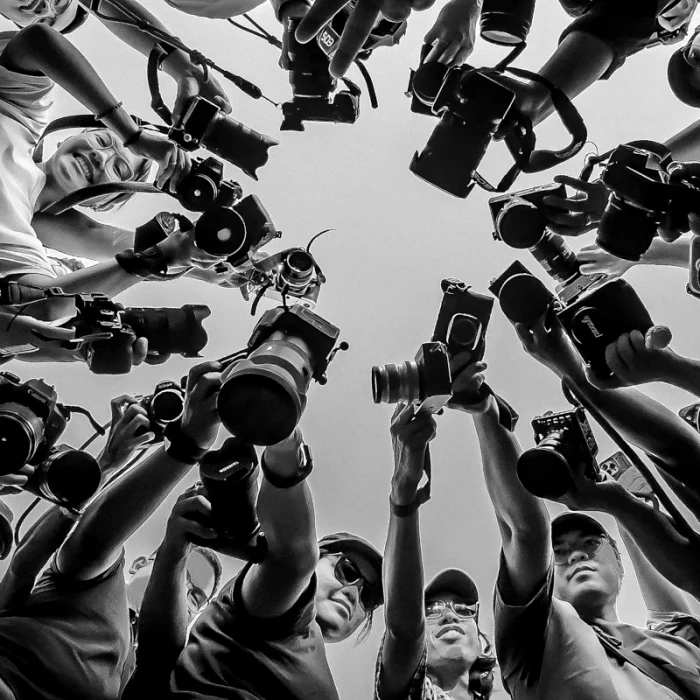
Traceability from the camera to the file broadcast.
Why make the origin of an image verifiable?
Chaque œuvre est accompagnée de son certificat d’authenticité. Il établit son identité, sa provenance et sa place au sein d’une édition limitée ou d’une œuvre unique.
Nous avons conçu un certificat intégrant plusieurs dispositifs de sécurité exclusifs. Chaque exemplaire possède ainsi une identité propre, directement liée à l’œuvre qu’il accompagne.
Le certificat précise les informations essentielles : Artiste, titre, dimensions, technique, numéro d’édition et nombre d’exemplaires.
Accessible à tous, tout en répondant aux attentes des collectionneurs, il accompagne l’œuvre dans le temps et contribue à préserver son identité, sa traçabilité et sa valeur patrimoniale.
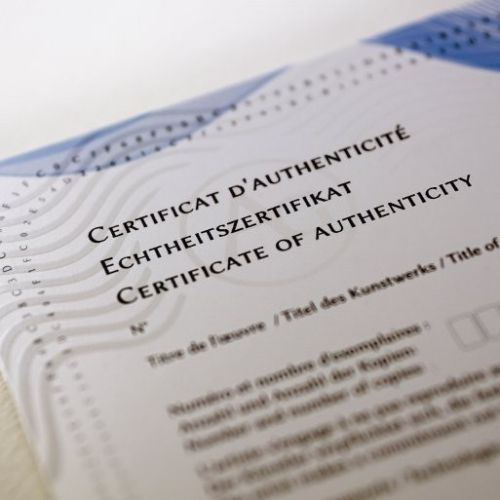
Jedes Werk wird von seinem Echtheitszertifikat begleitet. Es etabliert seine Identität, Herkunft und seinen Platz in einer limitierten Auflage oder einzigartigen Werke.
Wir haben ein Zertifikat entworfen , das mehrere exklusive Sicherheitsmerkmale enthält. Jede Kopie hat somit ihre eigene Identität, die direkt mit dem Werk verbunden ist, das sie begleitet.
Das Zertifikat gibt die wesentlichen Informationen an: Künstler, Titel, Maße, Technik, Ausgabenummer und Anzahl der Exemplare.
Für alle zugänglich und erfüllt gleichzeitig die Erwartungen der Sammler, begleitet es das Werk im Laufe der Zeit und trägt dazu bei, seine Identität, Rückverfolgbarkeit und seinen Kulturerbewert zu bewahren.
Each work is accompanied by its certificate of authenticity. It establishes its identity, provenance and place within a limited edition or unique work.
We have designed a certificate that incorporates several exclusive safety features. Each copy thus has its own identity, directly linked to the work it accompanies.
The certificate specifies the essential information: Artist, title, dimensions, technique, edition number and number of copies.
Accessible to all, while meeting the expectations of collectors, it accompanies the work over time and helps to preserve its identity, traceability and heritage value.